I ran the transition in the Aiyagari example and it converged successfully. However, there is something a little weird. I show below the transition path for aggregate capital K_t
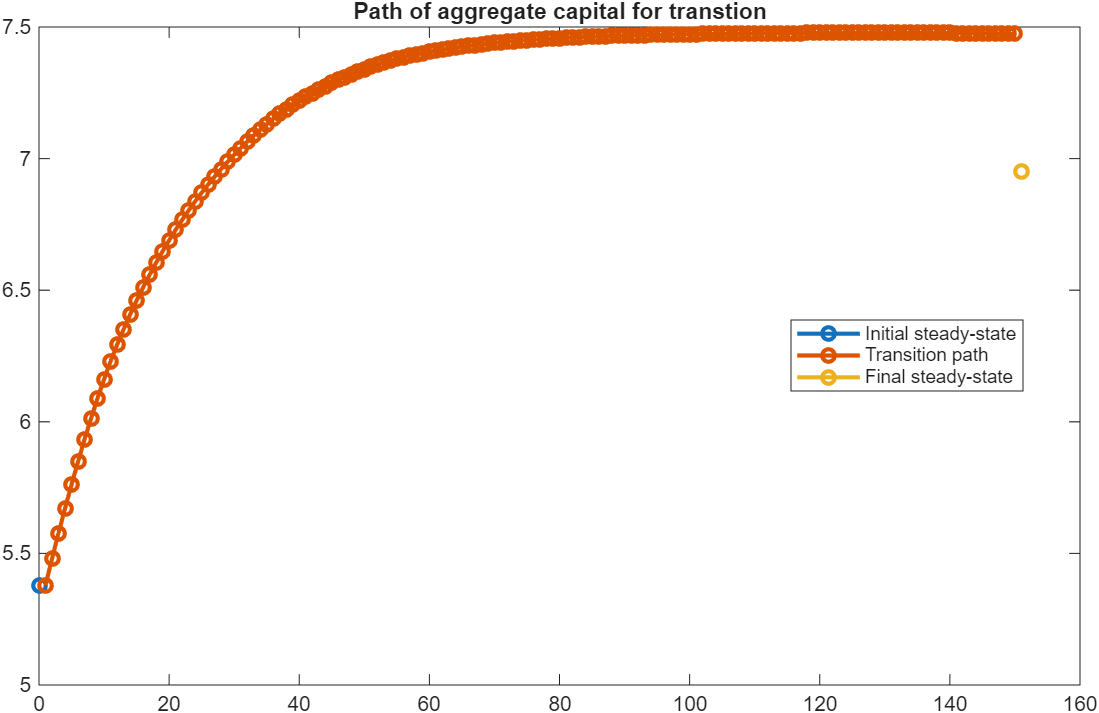
As you can see, the transition path for K_t seems to overshoot the value of K in the final steady-state. In particular,
AggVarsPath.K.Mean(T)

ans =

          7.47352479349525

>> AggVars_final.K.Mean

ans =

          6.95178791465384

>> (AggVarsPath.K.Mean(T)-AggVars_final.K.Mean)/AggVars_final.K.Mean

ans =

        0.0750507474115592
So the difference is about 7.5 percent of the aggregate capital stock, which is not negligible.
The tolerance criterion for the transition is
transpathoptions.tolerance = 10^(-6); % default is 10^(-5)
I’m asking this question because I found the same problem in other, more complex models, with a totally different code. So probably the toolkit code is OK, but I always wondered what is going on 
My understanding is that the transition path should converge to the value in the final steady-state. If not, one should either increase T or reduce the tolerance. But in this case clearly T is large enough and the tolerance is already small, so…