Very interesting! I have not managed yet to run the transition using the vfi toolkit, but I have coded myself the Huggett 1997 model. The files are available in my repo here: GitHub - aledinola/Huggett_1997, see folder cpu.
I set T = 100 and the transition converges, getting similar results to what you have shown. I have a number of observations that I summarize below:
- I set a high number of grid points for assets, na=2000, to make sure the computation is accurate enough. The model is simple so we can afford many grid points.
- I compare the stationary equilibrium in my code and in the toolkit and there are small differences, using exactly the same parameters for tolerance, max number of iterations etc.
Toolkit results:
RESULTS FINAL STEADY STATE, VFI TOOLKIT
Algorithm: pure discretization
No. grid points assets: 2000
CapitalMarket residual: -0.004739
Goods market residual:  -0.000195
Aggregate capital:      4.311640
Capital-to-labor ratio:  4.311640
Capital-to-output ratio: 2.547835
Consumption:             1.261308
Interest rate:           0.041296
Wage:                    1.083057
Run time General Equil: 8.772723
My code results:
FINAL STEADY-STATE, OWN CPU CODE:
Algorithm: pure discretization
No. grid points assets: 2000
CapitalMarket residual: 0.001356
Goods market residual:  0.000052
Capital stock:           4.311645
Capital-to-labor ratio:  4.311645
Capital-to-output ratio: 2.547836
Consumption:             1.261061
Interest rate:           0.041296
Wage:                    1.083057
Run time General Equil: 6.970329
- As I said, I am not able to compute the transition with the toolkit, but I computed it with my code and it converges with
tolerance = 10^(-3)andT=100and dampening parameter equal to 0.9 - The transition seems pretty robust but completely different from what Huggett (1997) reports.
- As @yechen observed, I also noticed that towards the end, K(t) seems to drift down. Does this mean that the transition is not accurate? I don’t know. I had found a similar problem in this older post.
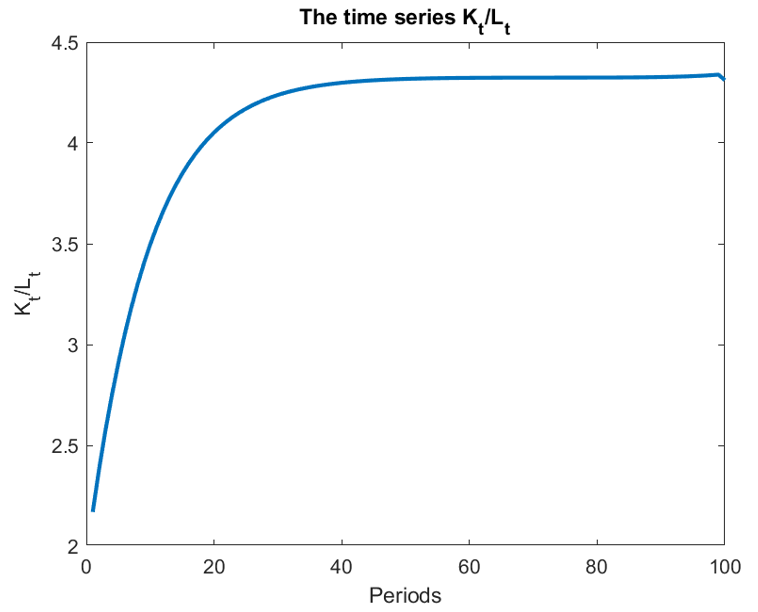
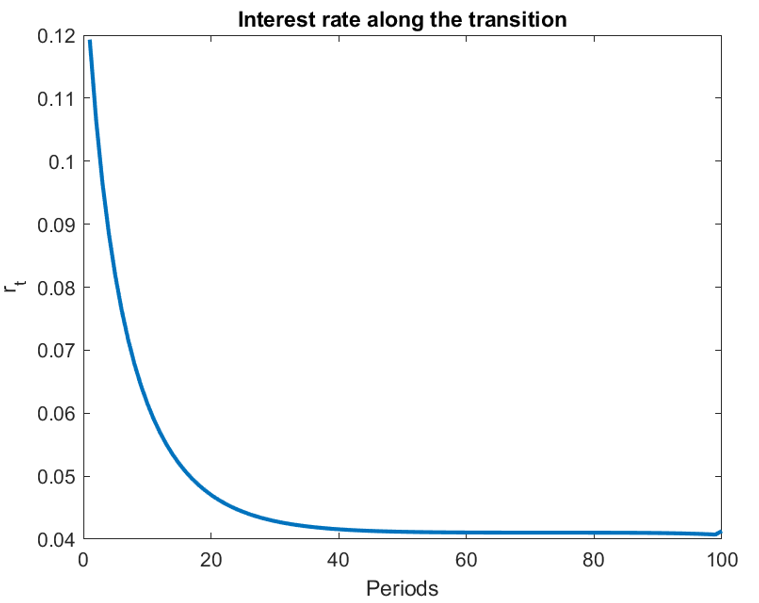
In the first plot above I show K(t)/L(t) but this is the same as K(t) since average labor is always equal to 1 in this particular model.
Update
Huggett (1997) writes that he used T=1000 while I used T=100. I will recompute the transition with T=1000, but I am sceptical that the results will change substantially. I assume the original code is not available since this is an old paper…