Universal basic income and negative income tax

I came across this really nice paper on UBI and negative income tax. The paper explores a relevant and timely issue that has been debated a lot in a very simple model.

Replicating this paper can be a nice exercise for someone who wants to learn the VFI toolkit. Steady-state and transition can be done on a laptop GPU, from what I have seen.

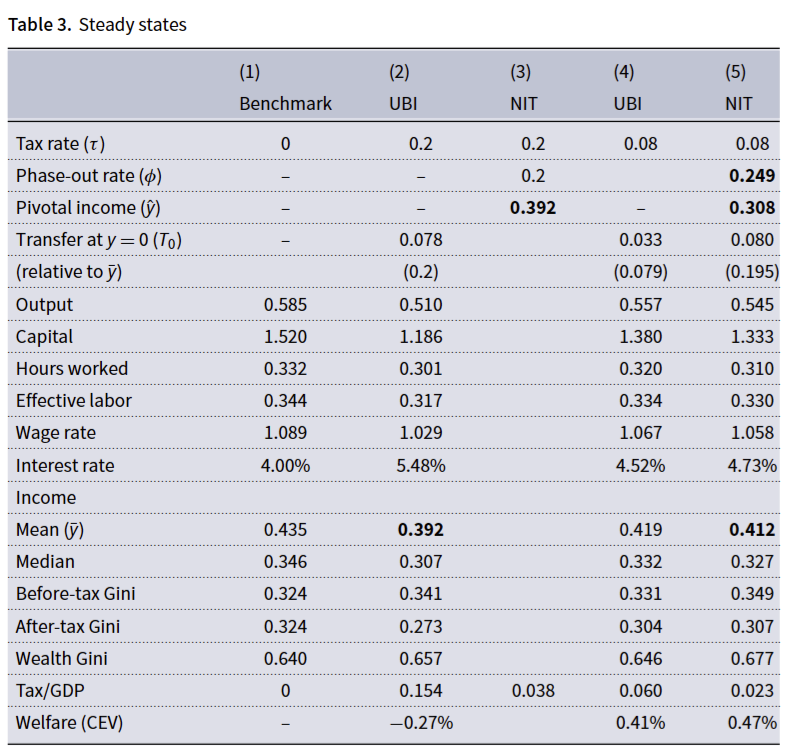
I’m doing the exercise using the VFI toolkit. Thanks for the example script of Aiyagari (1994)—it’s easy to ‘replicate’ the benchmark and UBI cases. The quotes around ‘replicate’ are because there are a few details regarding the numerical solution that are lacking in the paper, such as the number of grid points and the method for discretizing the AR(1) process. As a result, I cannot get the exact results.

===========Benchmark=============
Tax rate          : 0.000 
Transfer at y=0   : 0.000 
relative to y_bar : 0.000 
Output            : 0.589 
Capital           : 1.521 
Hours worked      : 0.321 
Effective labor   : 0.346 
Wage rate         : 1.091 
Interest rate     : 3.952 
Mean(y_bar)       : 0.437 
Median            : 0.321 
Mean-Median ratio : 1.362 
Before-tax Gini   : 0.389 
After-tax Gini    : 0.389 
Wealth Gini       : 0.691 
Tax/GDP           : 0.000 
==================================
===========UBI reform============
Tax rate          : 0.200 
Transfer at y=0   : 0.062 
relative to y_bar : 0.200 
Output            : 0.484 
Capital           : 1.130 
Hours worked      : 0.265 
Effective labor   : 0.300 
Wage rate         : 1.031 
Interest rate     : 5.425 
Mean(y_bar)       : 0.371 
Median            : 0.263 
Mean-Median ratio : 1.411 
Before-tax Gini   : 0.422 
After-tax Gini    : 0.422 
Wealth Gini       : 0.700 
Tax/GDP           : 0.153 
==================================

However, I ran into trouble while writing code for the NIT case. My question is how to properly set up the FnsToEvaluate function when the budget constraint is piecewise linear. The issue is that some agents pay proportional taxes while others receive transfers, depending on their income relative to a cutoff. Moreover, this cutoff income can be endogenously determined by the government budget balance constraint. A few papers feature this structure, such as Ventura (1999) and Hsu et al. (2013).

1 Like

The file https://github.com/vfitoolkit/IntroToOLGModels/blob/main/OLGModel5_ProgressiveIncomeTaxFn.m provides an example of a computed income tax. In this case, the computation is a clever combination of parameters that yield a continuous function that is both an accurate approximation of the US Tax system and also allows for GE models to tweak the parameters to find equilibriums.

I suspect that if you hard-code a set of rules such as

if Income > 0 && Income < 0.1
    tax1 = 0.01 * Income; % The nuisance of taxing the poor
    if Income==0.0123
        tax1=-10; % Lucky people with precisely this income get a transfer
    end
end
if Income >=0.1 && Income < 0.3
    tax2 = 0.07 * Income-0.1; % The next progressive chunk
end
if Income >=0.3 && Income < 0.8
    tax3 = 0.15 * Income-0.3; % The next progressive chunk
end
if Income >=0.8 && Income < 2
    tax4 = 0.25 * Income-0.8; % The next progressive chunk
end
if Income >=2 && Income < 4
    tax5 = 0.39 * Income-2; % The next progressive chunk
end
if Income > 4
    tax6 = 0.45 * Income-4; % The last progressive chunk
end

tax6=min(1, tax6); % Psych! Tax breaks for the rich on that last piece

tax = tax1+tax2+tax3+tax4+tax5+tax6;
% overall tax rate = tax/Income; billionaires have infinitesimal tax rates

This will give you a progressive tax, but one that is fixed. So it can force your GE to find solutions by changing things other than tax. Was that the problem you were trying to solve?

2 Likes

Appreciate the details. I’ll go through them and follow up with my progress.

1 Like

In that case the best way is to define the function to be evaluated as a M-file.

First, you define a fucntion that given the variables (a’,a,z) and some parameters computes the income tax liability:

function tax = f_income_tax(aprime,a,z,alpha,r,delta,tau)
% Linear income tax

w      = (1-alpha)*((r+delta)/alpha)^(alpha/(alpha-1));
income = w*z+r*a;

% Here it will be more complicated: add tax brackets and tax rates
tax = tau*income;

end

Second, you add this function to the functions to evaluate

FnsToEvaluate.income_tax = @(aprime,a,z,alpha,r,delta,tau) f_income_tax(aprime,a,z,alpha,r,delta,tau);

Then the toolkit will compute the total income tax as AggVars.income_tax.Mean. The variable income_tax can be used as an input to general equilibrium conditions. Suppose for example you want to add a condition for government budget constraint:

GeneralEqmEqns.Gov = @(G,income_tax) G - income_tax;

where you impose that in equilibrium total income taxes equal government spending G.

Note: if your model features endogenous labor supply, the ‘always required variables’ are not (a’,a,z) but (d,a’,a,z).
2 Likes