A few months ago I lamented the behavior of my agents (Deadbeat agents and feasibility constraints). I’ve gotten better at not putting them into impossible positions, and they’ve gotten better at surprising me with their optimal solution-finding. The latest shows their decision-making when they have an option to purchase a solar endowment in the face of ever-rising fossil-fuel prices:
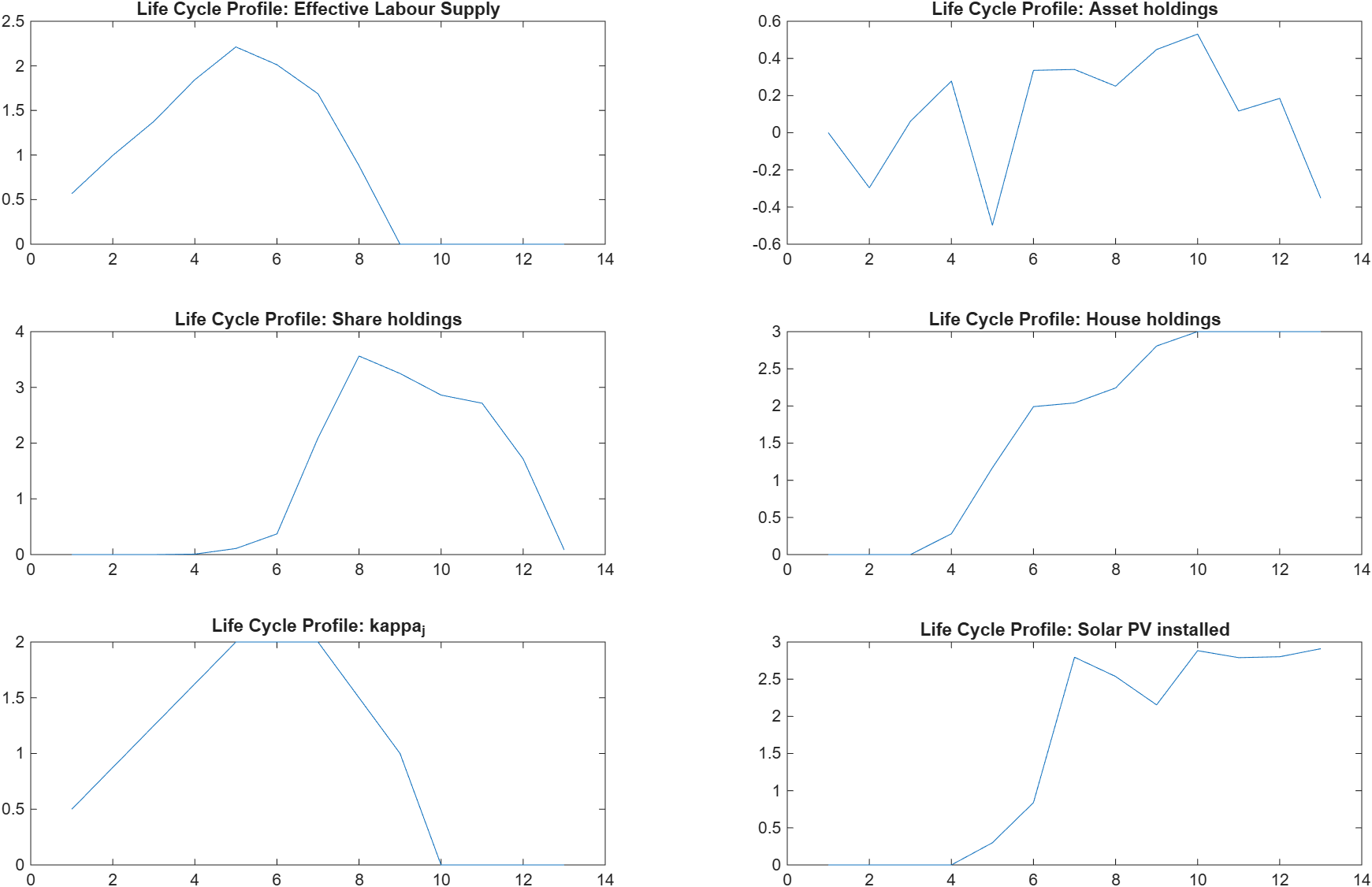
Previously, they would accumulate assets, putting them into high-yield shares (which are quantized like bonds, so they put small-money into low-yield savings), then when they had enough money, they’d buy a house for the benefits of receiving better housing services, then they’d sell the house and live off the proceeds until their died. Everything was hump-shaped.
Now, in the face of relentless increases in fossil fuels over time, they choose to buy their house, install solar, and then benefit from the endowment of self-generated power that greatly reduces their exposure to increasing energy costs. Clever agents!
Now I have a new problem: I currently follow a simplistic model whereby shares, assets, and houses feed into accidental bequests at their market value, with beneficiaries receiving the (small) average of those bequests. Those bequests satisfy the consumption formula, which allows agents to otherwise use accumulated assets for other purposes, such as house and solar PV acquisition. But in reality, some agent could inherit the house and its solar endowment, and this is not a “decision” per se. But perhaps this could be modeled as a kind of a shock which, when observed by an agent, makes the “decision” of buying a fully equipped house with some amount of solar PV capacity a no-cost option cost.
Presently I used the buyhouse decision function from LifeCycleModel35. I could add a purchase type of “inherit” which would only be satisfied if the shock type and value indicated they were the beneficiary. Is that a good way to think about it? Is it worth considering the case whereby real property is bequested, or do most economists argue (existentially?) that one will get essentially the same answer by converting everything to cash and distributing that?